


Introduction
If you’re buying equipment for your farm this year, the tax rules are working in your favor like they haven’t in many years. Section 179 and bonus depreciation for farm equipment both got dramatically better under the 2025 OBBBA tax law, and for 2026 a grower can write off virtually any qualifying equipment purchase in the year it’s placed in service.
The headline numbers: the Section 179 limit is up to $2,560,000, and 100% bonus depreciation is back, and now permanent. Together they mean a new tractor, combine, or irrigation system can generate a full first-year deduction instead of a slow schedule stretching across many years.
But the details decide how much you actually save: which assets qualify, how the two tools interact, the special rules for vehicles, and the trap that catches every California grower , a state that refuses to follow any of these favorable depreciation rules. This 2026 update walks through all of it, so your next equipment purchase delivers the deduction you’re planning on. Truck, trailer, golf cart, airplane, ATV helicopter, what ever you use in conducting your business. Then don’t forget QPP.
The 2026 Numbers: What Changed
Start with the figures, because they’re the foundation of every equipment decision this year.
Section 179 expensing for tax years beginning in 2026 allows a maximum deduction of $2,560,000. The deduction phases out dollar-for-dollar once total qualifying purchases exceed $4,090,000, and disappears entirely at $6,650,000. Section 179 is capped at your business’s taxable income, it can’t create a loss, and any amount limited by income carries forward to the next year.
Bonus depreciation is the bigger story. The 2025 tax law permanently restored 100% bonus depreciation for qualifying property acquired *and* placed in service after January 19, 2025. Unlike the old schedule that was phasing down toward zero, the 100% rate now has no scheduled expiration. Bonus depreciation has no dollar cap and, unlike Section 179, it can create or increase a loss , which makes it powerful for a grower with off-farm income to shelter.
Both tools apply to new and used equipment, as long as the used item is new *to your operation*. The practical result: for 2026, a farm can generally deduct the full cost of its equipment purchases in year one.
Which Farm Assets Qualify , and Over What Life
Not every asset behaves the same way, and knowing the recovery periods helps you plan. Qualifying property for these deductions is generally tangible property with a recovery period of 20 years or less , which covers essentially all farm equipment.
Here’s how common farm assets are classified under MACRS:
- Farm machinery and equipment (tractors, combines, implements): generally a 5-year or 7-year recovery period
- Grain bins: 7-year
- Vegetable cooler building 20 year
- Single-purpose agricultural or horticultural structures (certain livestock and greenhouse structures): 10-year
- Fences, drainage tile, wells, and land improvements: 15-year
- General-purpose farm buildings (machine sheds, barns): 20-year
Every one of these , being 20-year property or less , qualifies for 100% bonus depreciation federally. That’s a meaningful expansion of what growers can write off immediately: it’s not just the tractor, but the irrigation system, the drainage tile, the grain bins, and the fencing. What generally *doesn’t* qualify is land itself (never depreciable) and buildings with recovery periods over 20 years.
Section 179 vs. Bonus: How to Use Them Together
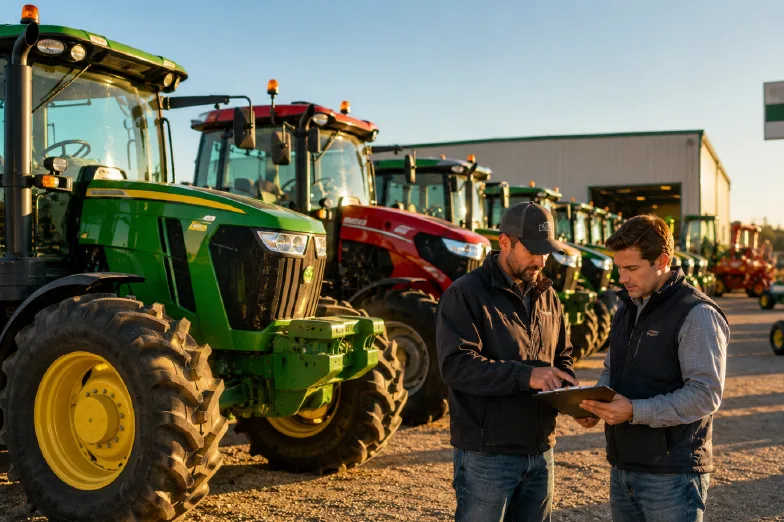
With both tools at 100%, growers ask why they’d bother with Section 179 at all. The answer is that they behave differently, and the smart play uses each for what it does best.
The standard sequence is Section 179 first, then bonus depreciation, then regular MACRS on any remaining basis. But the more important insight is *when to favor which*. Section 179 is precise, you can apply it to specific assets and specific amounts, which lets you dial your taxable income to an exact target. But it’s capped at business income and can’t create a loss. Bonus depreciation is blunt but powerful, it hits an entire class of property at 100% and *can* run past income into a carry forward loss that shelters other income.
So, a grower who wants to zero out farm income but not go negative might use Section 179 to hit that line precisely. A grower with W-2 wages or a spouse’s income to shelter might lean on bonus depreciation to create a deductible loss. And a grower watching the §199A qualified business income deduction might deliberately *not* deduct everything, because a large write-off shrinks QBI, sometimes making a partial deduction. The tools are levers; which you pull depends on the income you’re aiming at and your desired tax planning posture.
The Vehicle Rules Every Grower Gets Wrong
Farm vehicles have their own layer of limits that sit on top of everything above, and they trip up growers every year.
Heavy equipment and specialized vehicles, anything not likely to be used personally, qualify for full Section 179 and bonus depreciation. Heavy trucks and vans over 14,000 lbs GVWR (many farm trucks) are also unrestricted. But two categories are capped:
- SUVs between 6,000 and 14,000 lbs GVWR: Section 179 is limited to $32,000 for 2026, though the remaining cost can often be recovered with 100% bonus depreciation.
- Passenger cars and lighter trucks/vans (6,000 lbs GVWR or less): subject to the 280F “luxury auto” caps , roughly $20,400 in first-year depreciation with bonus for 2026.
- The takeaway: a heavy work truck used for the farm can often be fully deducted, while a lighter pickup or a passenger vehicle is throttled by the luxury-auto caps no matter how you elect. And all of it requires more than 50% business use, documented with a real, contemporaneous log. Buy the vehicle that fits both the work and the write-off.
A Deeper Look: The California Add-Back That Erases the Benefit
Here’s the section that matters most for a California grower and that no generic depreciation article addresses: California does not conform to any of this favorable accelerated depreciation.
The state caps Section 179 at $25,000, not $2.56 million, with a phase-out beginning at just $200,000 of purchases. California fully disallows bonus depreciation; the state did not adopt the 2025 federal law at all. So, the $300,000 planter you write off completely on your federal return must be added back to your California income in year one, then depreciated slowly over its normal MACRS life on the state return.
The mechanical consequence: every asset you buy now carries two basis figures and two depreciation schedules for its entire life, a fast federal one and a slow California one. They diverge immediately and stay divergent. When you eventually sell that equipment, your federal and California gains differ, because your California basis is still higher (you’ve depreciated less of it), which flows into different depreciation recapture on each return.
None of this means you shouldn’t take the federal deductions, they’re real and large. It means you must track both from day one, plan for the California income the add-back creates, and budget estimated state tax payments accordingly. A grower who models only the federal side of a big equipment year can get blindsided by a California bill they never saw coming. Plan for the gap; don’t be surprised by it.
Practical Tips for Farm Equipment Depreciation in 2026
- Watch the placed-in-service date. The deduction follows when equipment is ready and available for use, not when it’s ordered or paid for. A machine delivered in January is a next-year deduction.
- Use Section 179 to hit a precise income target. Because it can’t create a loss, it’s the tool for dialing farm income to an exact number.
- Use bonus depreciation to shelter outside income. It can create a loss, so it’s the tool when you have W-2 or spouse’s income to offset.
- Mind the §199A interaction. Deducting everything can shrink your QBI deduction. Sometimes partial expensing or the 40% bonus election saves more.
- Buy the right vehicle. Heavy work trucks over 14,000 lbs GVWR avoid the caps; SUVs are limited to $32,000 of Section 179; light and passenger vehicles are throttled by the luxury-auto limits.
- Track federal and California basis separately for every asset. The state add-back is permanent and follows the asset to sale. Maintain a parallel California schedule.
- Model the whole equipment year before December. Coordinate 179, bonus, income averaging, and the California add-back together, not asset by asset.
Conclusion
For farm equipment, 2026 is about as good as the federal rules get: a $2.56 million Section 179 limit and permanent 100% bonus depreciation mean a grower can write off nearly any qualifying purchase , tractors, irrigation, tile, grain bins, fencing, in the year it’s placed in service. The nuance is in the coordination: Section 179 for precision, bonus for sheltering outside income, and a careful eye on the §199A and vehicle rules.
For California growers, the recurring footnote is the one that bites hardest: the state follows none of it, so every federal write-off becomes state income to plan around. Before your next major equipment purchase, model the federal deduction, the California add-back, and the income you’re targeting with a specialist, the timing of that one decision often matters more than the deduction itself.
Frequently Asked Questions
Q: How much can I deduct on farm equipment with Section 179 in 2026?
A: For tax years beginning in 2026, the federal Section 179 limit is $2,560,000, phasing out dollar-for-dollar above $4,090,000 in total qualifying purchases and gone entirely at $6,650,000. Section 179 can’t exceed your business taxable income. California, by contrast, caps its Section 179 deduction at just $25,000.
Q: Is bonus depreciation available on farm equipment in 2026?
A: Yes. The 2025 tax law permanently restored 100% bonus depreciation for qualifying property acquired and placed in service after January 19, 2025. It applies to new and used farm equipment with a recovery period of 20 years or less, has no dollar cap, and can create a loss. California, however, does not allow bonus depreciation.
Q: What farm equipment qualifies for bonus depreciation?
A: Tangible farm property with a recovery period of 20 years or less qualifies, including tractors and machinery (5- or 7-year), grain bins (7-year), single-purpose agricultural structures (10-year), vegetable cooler buildings, and fences, drainage tile, and land improvements (15-year). Land itself is never depreciable, and buildings over a 20-year recovery period don’t qualify.
Q: Should I use Section 179 or bonus depreciation for my tractor?
A: It depends on your income target. Section 179 is precise and can’t create a loss, so it’s ideal for dialing farm income to an exact figure. Bonus depreciation can create a loss, making it better when you have off-farm income to shelter. Many growers use Section 179 first, then apply bonus depreciation to the remaining basis.
Q: Can I write off a farm truck under Section 179?
A: Often, yes. Heavy work trucks over 14,000 lbs GVWR aren’t subject to the vehicle caps and can be fully deducted. SUVs between 6,000 and 14,000 lbs are limited to $32,000 of Section 179 for 2026, with the remainder eligible for bonus. Lighter and passenger vehicles are limited by the §280F luxury-auto caps, and over-50% business use is required.
Q: Does California allow Section 179 and bonus depreciation on farm equipment?
A: Only in part. California caps Section 179 at $25,000 (phasing out above $200,000 of purchases) and fully disallows bonus depreciation. Equipment you fully expense federally must be added back to California income and depreciated over its normal life, so your federal and state depreciation, and later your gain on sale, will differ.