

Introduction
The hardest asset to pass down isn’t a portfolio or a building, it’s a farm. Land, equipment, water rights, and a living business all have to move to the next generation without forcing a sale to pay taxes or fracturing a family. A sound California farm succession plan is what makes that possible, and 2026 is an unusually good moment to build one.
Succession planning has become a profession, a discipline, and, increasingly, a science. It is no longer simply about preparing a will or deciding who receives the farm. Modern succession planning brings together tax law, estate planning, business governance, and the psychology of family relationships.
We now understand that successful transitions depend as much on people as they do on legal documents. Brothers, sisters, cousins, and in-laws may see the future very differently. A skilled succession specialist identifies these pressures early, creates clear lines of authority, and establishes a fair process for resolving disagreements before they become family battles.
The goal is simple: protect the business, preserve family relationships, and prepare the next generation to lead. Good succession planning does not begin at retirement. It begins years earlier, while there is still time to teach, test, adjust, and unite.
The federal estate tax exemption just jumped to $15 million per person and was made permanent, which removes some farm families from federal estate tax entirely. California, helpfully, imposes no state estate or inheritance tax at all. That combination gives California growers room to plan calmly rather than defensively but it doesn’t make planning optional. The threats to a family farm are rarely just taxes; they’re the lack of a plan when the unexpected happens.
This guide lays out a five-step framework for California farm succession the exemptions and tools that matter, how to keep the land valued as a farm, and why the order you do things in changes the outcome.
Step 1 — Know Your Numbers: The 2026 Exemption Landscape
Every succession plan starts with a clear picture of where you stand against the tax thresholds, because that determines how much planning you actually need.
For 2026, the federal estate and gift tax exemption is $15 million per individual if structured wisely then $30 million for a married couple and it was made permanent by the enactment of the 2025 tax law, OBBBA, indexed for inflation going forward. The top estate tax rate above the exemption remains 40%. This means that anything above $15 million is taxed at the 40% rate. Thus 1 million over and you pay the US government $400,000. The generation-skipping transfer (GST) tax exemption matches at $15 million, which matters if you want to pass land or assets directly to grandchildren. This creates many planning opportunities if you like your grand children!
Two facts reshape the picture for California growers specifically. First, California has no state estate tax, so unlike families in Oregon, Washington, or New York, you’re only planning against the federal number. Second, most family farms may fall *under* $15 million per owner, meaning the many of California farm estates owe no federal estate tax at all. If that’s you, your plan shifts from tax avoidance to something arguably more important: making sure the land, the business, and the decisions transfer cleanly. Know your number first it tells you which of the following steps you truly need.
Step 2 — Protect the Land’s Value: Special-Use Valuation
For families whose land value pushes them over the exemption often because the ground sits near a growing town and is worth far more as development than as farmland. The land may now be more useful for planting houses than planting avocados! Valuation is affected by the growth of the surrounding area.
Section 2032A special-use valuation lets a qualifying estate value farmland at its agricultural use value rather than its “highest and best use” (development) value. On land near a metro or resort area, that difference can be enormous. The reduction is capped, just over $1.4 million for 2026, indexed annually, but for an estate straddling the exemption line, that reduction can eliminate the tax entirely.
The catch is the commitment. To qualify, the land must pass to a qualified heir (a spouse or lineal descendant), the decedent or family must have owned and materially participated in the farming for five of the eight years before death, and — critically — the heir must continue the qualifying farm use for 10 years after death or face a recapture of the tax that was saved. It’s a powerful tool for a farm family genuinely committed to keeping the ground in production, and a trap for one that might sell. Use it deliberately, with counsel.
Step 3 — Don’t Give Away the Basis Step-Up
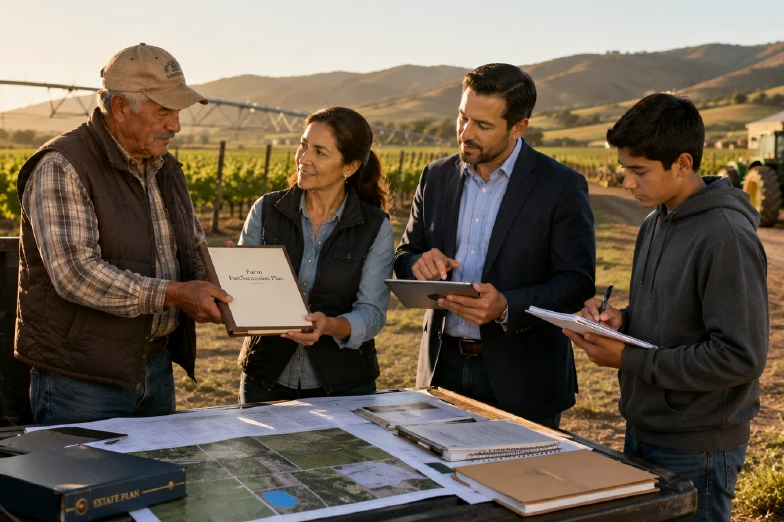
Here’s the counterintuitive move that trips up well-meaning families: don’t rush to gift the farm during your lifetime. For most California growers, holding the land until death is now the better tax play.
The reason is basis. When you gift an asset, the recipient takes your original cost basis , often very low on farmland owned for decades. When they later sell, they owe capital gains tax on all the appreciation since *you* bought it. But when an heir inherits the land at your death, they generally receive a stepped-up basis to the fair market value on the date of death under Section 1014, wiping out decades of built-in gain. Quite obviously this is better. Sell shortly after inheriting, and there may be little or no capital gains tax at all. You may want to have your trust require the beneficiary to continue farming for a designated period of time before selling. The trust is a great tool to carry out your wishes into the future.
In the past (1960 and before) many times the boys got the farming business and the girls got the land and then rent checks. Massive appreciation sometimes created an unintended imbalance.
With the exemption at $15 million, most farm families no longer need to gift land during life to avoid estate tax , which means the old “gift it early” instinct now often *costs* the next generation a large capital gains bill they didn’t need to pay. The general rule for estates comfortably below the exemption: hold the appreciated land until death to capture the step-up. Gifting still has its place for very large estates or for moving future appreciation out, but for the typical California farm, the step-up is the prize. Don’t give it away by accident. One has to think in terms of the value of the business and the value of the land, then make an estate plan accordingly. Beware the Congress can change the exemption amount down the road!
Step 4 — Structure the Business, Not Just the Land
Land is only part of a farm. The operating business, equipment, contracts, water arrangements, receivables, and the day-to-day management, needs its own succession structure, and this is where families most often have nothing in place. Beware of creating a condition where siblings cannot get along long enough to work together.
The common move is to hold the farm in an entity, an LLC or a corporate structure, which does several things at once. It separates ownership (who holds the value) from management (who runs the farm), so you can hand the reins to the child who farms while still providing for children who don’t. It creates transferable units or membership interests, ie shares of stock, which are far easier to gift or sell in pieces than a fractional interest in dirt. And it allows a buy-sell agreement that sets, in advance, what happens if an owner dies, divorces, or wants out, preventing the forced sales and family disputes that destroy farms.
An entity also creates a clean path for gradually shifting ownership to the next generation over years (the subject of a companion piece), using annual gifts of units while keeping control until you’re ready to let go. The land, the entity, and the estate documents have to work together, a trust provision that contradicts a buy-sell, or an entity that ignores the estate plan, creates exactly the mess succession planning is meant to prevent. Hire a tax specialist that knows all the pieces to the puzzle.
Step 5 — Put It in Writing, and Keep It Current
The best-designed plan is worthless if it lives in your head. The final step is documentation and maintenance.
A complete California farm succession plan generally includes a will and/or revocable living trust (a trust also avoids California’s slow, expensive probate), the entity documents for the farm business, a buy-sell agreement, powers of attorney for finances and health care, and a clear management succession plan naming who runs the operation and in what capacity. Sometimes there are many sub-trusts to cover certain needs or causes.
Whatever the plan keep it current. The 2025 law changes made many older plans obsolete: trusts drafted for a feared exemption *drop* can now misdirect assets under the higher permanent exemption. Land values, family circumstances, and tax law all move, change or evolve. A plan reviewed every few years, and after any major event, stays aligned with what you actually want. A plan written once and forgotten quietly drifts out of date. The best way for succession to work is to place the beneficiaries in responsible roles while you are still here, teach them how to meet to communicate and make sound well-reasoned business decisions. Be on the lookout for the child that did not want to work under the strict direction of the parent, then after the death they develop a desire to carry on the family business.
Conclusion
California farm succession in 2026 is more about stewardship than tax avoidance, and that’s a good thing. With a $15 million permanent federal exemption and no California estate tax, most farm families are clear of estate tax and free to focus on the real goal: transferring the land, the business, and the decision-making intact. The tools, the basis step-up for nearly everyone, an entity to structure the business, and current documents to hold it all together, work best in sequence and together.
Succession planning should begin early, long before retirement or a family crisis forces difficult decisions. Siblings and cousins, even in close families, do not always work well together when money, control and authority are involved. Thoughtful planning may include separate entities for real estate and individual business operations, creating clearer ownership and management responsibilities. Begin passing the reins early so future beneficiaries learn to lead, communicate and work together while senior leadership can still provide guidance. Most importantly, establish a clear process for resolving family disputes before disagreements threaten the business or family.
The one thing no framework can replace is starting. Sit down with an agricultural estate tax specialist and build the plan while you can shape it deliberately, because the alternative is your family sorting it out under pressure, at the worst possible time, without your guidance.
Frequently Asked Questions
Q: What is a farm succession plan?
A: A farm succession plan is a coordinated strategy for transferring a farm’s land, equipment, business, and management to the next generation or new owners. It combines estate documents, business structure, entity structure, tax planning, and a management transition plan to keep the farm operating and in the family without a forced sale.
Q: How much can I pass to my heirs without estate tax in 2026?
A: For 2026, the federal estate and gift tax exemption is $15 million per person, or $30 million for a married couple using portability, and it is now permanent with inflation adjustments. California imposes no state estate or inheritance tax, so California farm families plan only against the federal threshold.
Q: Should I gift the farm to my children now or leave it to them?
A: For most farm families under the $15 million exemption, leaving the land at death is better because heirs receive a stepped-up basis to fair market value, erasing decades of capital gains. Gifting passes your low original basis to them. Lifetime gifting mainly benefits very large estates seeking to move future appreciation out.
Q: Does California have an estate tax on farms?
A: No. California does not impose a state estate tax or inheritance tax, so California farm families plan only against the federal estate tax. This is a meaningful advantage over growers in states like Oregon, Washington, or New York, which impose their own death taxes at much lower thresholds.
Q: Why put the farm in an LLC or family partnership?
A: An entity separates ownership from management, so you can give some ownership to the child who farms while providing for those who don’t. It creates transferable interests that are easy to gift or sell in pieces, and it supports a buy-sell agreement that prevents forced sales and disputes when an owner dies, divorces, or exits.