

Introduction
An avocado grove is a 3 to 6 year-long investment before it hits full stride, and the tax code treats it accordingly. Getting avocado orchard tax deductions right means understanding two things most growers underestimate: the establishment costs you *can’t* deduct right away, and the enormous operating costs, fumigation, drip systems, fertilizer and water. That you can deduct.
California grows nearly all of America’s avocados, mostly across San Diego, Ventura, Santa Barbara, and Riverside counties, often on steep, water-hungry hillsides that are in the vicinity of an ocean breeze. That geography drives the tax picture. Water is frequently the single largest line on a grower’s return, and the multi-year climb to a marketable crop puts avocados squarely inside the pre-productive capitalization rules that trip up so many orchard operators.
This guide walks through what’s deductible, what has to be capitalized and recovered later, and where California’s refusal to follow federal depreciation rules can quietly raise your state tax bill. If you’re planting, replanting, or already producing, these are the rules that decide your after-tax return.
The Pre-Productive Period: What You Can’t Deduct Yet
Plant an avocado grove and you’ll wait roughly three to five years for a commercial crop. During that stretch, the instinct to deduct your costs as you spend runs headfirst into Section 263A.
Avocados sit on the IRS’s list of plants with a pre-productive period of more than two years. Under the uniform capitalization (UNICAP) rules, most direct and indirect costs of establishing the grove during that period must be capitalized, not deducted — the young trees, planting, irrigation, pruning, fertilizing, frost protection, management, and even depreciation on the equipment used to raise them. Those costs get added to the trees’ basis and recovered later, through depreciation, once the grove is productive.
The pre-productive period ends at your first marketable harvest, a crop in genuinely commercial quantities, not the handful of fruit a few young trees might set early. That distinction matters, because it fixes the year your capitalized costs stop accumulating and your regular operating deductions begin. This has been tested through litigation in court.
The Small-Business Exception That Changes Everything
Most California avocado growers don’t actually have to live under the full weight of UNICAP — and this is the exception a general preparer often misses.
Under Section 263A(i), a farming business that meets the gross receipts test; average annual gross receipts at or below roughly $32 million for 2026 — is *excepted* from the uniform capitalization rules. If you qualify, and the vast majority of family avocado operations do, you can currently deduct or depreciate your pre-productive costs instead of capitalizing them. That turns years of establishment spending into usable deductions much sooner.
There’s a second prong, an election out under §263A(d)(3), but you should treat it as a trap, not a gift. Electing out forces you onto the alternative depreciation system (ADS) for all your farm assets, with longer recovery periods, and generally forfeits bonus depreciation on equipment. For a grower buying tractors, sprayers, and irrigation gear, that’s an expensive price to pay. The small-business exception under §263A(i) usually gets you the same current deductions without surrendering bonus depreciation. Confirm which door you’re walking through before you plant.
Water, Frost, and the Deductions That Dominate a Grove
Once your grove is producing, the operating deductions are where avocados get interesting, because they’re large and, in California, unusually water-driven.
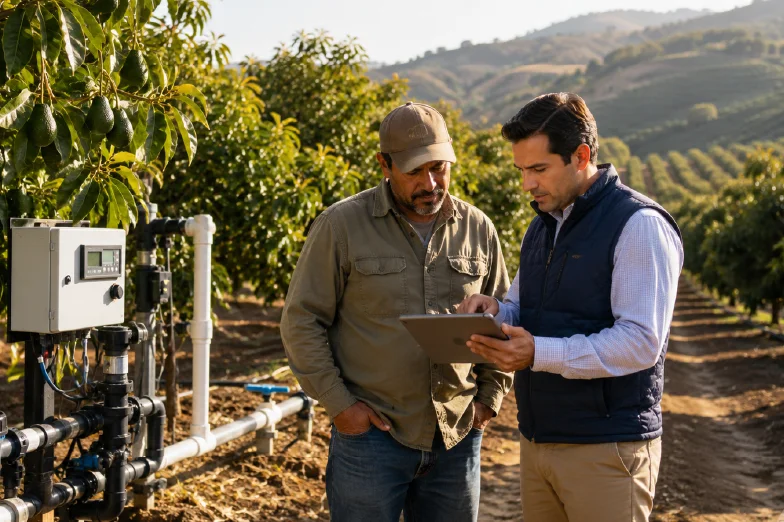
Water is typically the biggest deductible cost on an avocado return. Purchased irrigation water, pumping power, and water-district charges are ordinary, currently deductible operating expenses. In a drought year on a Ventura or San Diego hillside, that line can dwarf everything else, and it flows straight through Schedule F.
Beyond water, the grove generates a steady stream of deductible operating costs: fertilizer and soil amendments (with the §180 election available for the latter), pruning and grove maintenance, frost protection, pest and disease control, labor, and crop insurance premiums. Growers on hillside ground can also look to Section 175 soil and water conservation deductions for qualifying erosion control, terracing, and drainage work, a provision that turns what would be a capitalized land improvement into a current deduction, subject to the 25%-of-farm-income cap. These are the everyday deductions that determine your margin, and the ones a farm specialist makes sure you’re capturing in full.
A Deeper Look: Depreciating the Grove and Its Infrastructure
Once your avocado trees reach marketable production, all those capitalized establishment costs don’t just sit there, they start coming back to you through depreciation. Understanding the recovery is what separates a grower who plans from one who guesses.
The productive grove is depreciated over a defined recovery period (orchards and groves generally use a 10-year life), so the money you tied up during establishment is recovered steadily over the trees’ productive life. Layered on top of the trees is the infrastructure: irrigation systems, moisture detectors, micro-sprinklers, pumps, wells, frost-protection equipment, and grove machinery are all separately depreciable property, and under current federal law, much of it with a recovery period of 20 years or less qualifies for 100% bonus depreciation, permanently restored by the 2025 tax act for property placed in service after January 19, 2025.
Now the California catch, and it’s a big one for a capital-heavy grove. California does not conform. The state disallows bonus depreciation entirely and caps Section 179 at $25,000. So the irrigation system you write off in full federally must be added back to your California income and depreciated slowly on the state return — meaning every asset carries a separate federal and state basis for its entire life. On a new grove buildout with major irrigation and frost infrastructure, that federal-state gap can shift six figures of taxable income between the two returns in a single year. Track both from day one; reconciling it later is far harder.
Practical Tips for Avocado Grove Taxes
- Confirm your capitalization path before planting. Check whether you qualify for the §263A(i) small-business exception (gross receipts under ~$32M), and avoid the §263A(d)(3) election-out unless you fully accept losing bonus depreciation.
- Pin down your first marketable harvest year. That’s when the pre-productive period ends and capitalized costs stop accruing. Document the year the grove reached genuine commercial yield.
- Capture every dollar of water cost. Purchased water, pumping power, and district charges are fully deductible and usually your largest expense. Don’t let any of it slip through unrecorded.
- Use §175 for hillside conservation work. Erosion control, terracing, and drainage on sloped avocado ground may be currently deductible as soil and water conservation, rather than capitalized.
- Depreciate the infrastructure aggressively — federally. Irrigation, wells, pumps, and frost equipment qualify for 100% federal bonus depreciation. Just plan for the timing.
- Track the California add-back on every asset. Maintain a separate California depreciation schedule for anything you expense federally, so a big federal write-off doesn’t become a surprise state bill.
- Run income averaging after a big harvest. Avocado yields alternate between heavy and light years. Schedule J can spread a bumper-crop year’s income across leaner brackets.
Conclusion
Avocado taxation is a long game, and the growers who win plan for its shape. The pre-productive rules mean your establishment costs are recovered over later years, unless the small-business exception lets you deduct them sooner, which for most California growers it does. Water and grove-maintenance costs dominate the deduction side once you’re producing, and the infrastructure that keeps a hillside grove alive is prime depreciation territory federally. California’s non-conformity is the recurring footnote that turns aggressive federal write-offs into state income if you’re not tracking both.
None of this can be fixed at the time of filing, the capitalization choices are made at planting, and the depreciation tracking follows every asset for its life. If you’re establishing, replanting, or expanding a grove, talk to an agricultural tax specialist who knows California avocado tax rules before the year closes. The cost of getting the pre-productive rules wrong compounds quietly, year after year.
Frequently Asked Questions
Q: Are avocado orchard establishment costs tax deductible?
A: Not always immediately. Avocados have a pre-productive period over two years, so under Section 263A most establishment costs must be capitalized and recovered through depreciation once the grove is productive. However, growers meeting the small-business gross receipts test (about $32 million for 2026) can generally deduct or depreciate these costs currently instead.
Q: When does an avocado grove’s pre-productive period end?
A: It ends at the first marketable harvest, a crop produced in commercial quantities, not the first fruit young trees set. This point fixes when capitalized establishment costs stop accumulating and normal operating deductions begin, so documenting the year the grove reached genuine commercial harvested yield is important.
Q: Can I deduct water costs for my avocado orchard?
A: Yes. Purchased irrigation water, pumping power, and water-district charges are ordinary, currently deductible operating expenses reported on Schedule F. For California avocado growers, water is frequently the single largest deduction on the return, especially in drought years on hillside groves.
Q: How is an avocado orchard depreciated?
A: Once productive, the grove is depreciated over its recovery period , orchards and groves generally use a 10-year life. Separately, grove infrastructure like irrigation systems, wells, pumps, and frost equipment is depreciable property, and much of it qualifies for 100% federal bonus depreciation under current law.
Q: Does California allow bonus depreciation on avocado grove equipment?
A: No. California does not conform to federal bonus depreciation and caps Section 179 at $25,000. Irrigation and grove equipment you fully expense federally must be added back to your California income and depreciated over its normal life, so your federal and state depreciation will differ for each asset, unitl more farmers go to the Sacramento legislature and change the rule.
Q: Should I elect out of the capitalization rules for my avocado grove?
A: Usually not. Electing out under Section 263A(d)(3) forces you onto the alternative depreciation system for all farm assets and generally forfeits bonus depreciation. Most California avocado growers achieve current deductions instead through the small-business exception under Section 263A(i), which preserves bonus depreciation. Confirm your path with a farm tax specialist before deciding.