

Introduction
Most California growers assume their CPA is catching everything. Often they aren’t — not because they’re careless, but because California farm tax deductions live in corners of the code a general practice rarely visits. Soil and water conservation, fertilizer expensing, weather-related deferrals, the federal fuel tax credit: these are farmer-only provisions, and a preparer who handles mostly restaurants and contractors simply doesn’t reach for them.
The cost of that gap is real. A grower can overpay by thousands of dollars a year, every year, and never know it, because a missed deduction leaves no trace on the return. You can’t see what isn’t there.
This article walks through the deductions and credits that general CPAs most commonly miss for California farms and ranches, plus the state conformity quirks that make each one trickier than it looks. If your preparer has never mentioned most of these, that tells you something.
Soil and Water Conservation Expenses (Section 175)
Normally, when you improve land, level a field, build a drainage system, control erosion, those costs get capitalized and recovered slowly, if at all. Section 175 breaks that rule down for farmers.
If you’re in the business of farming, you can *currently deduct* qualifying soil and water conservation expenditures: leveling, grading, terracing, contour furrowing, drainage ditches, earthen dams, and the eradication of brush, among others. Instead of capitalizing a major land improvement, you write it off the year you pay for it, subject to a cap of 25% of your gross income from farming, with any excess carrying forward.
The catch that trips up general preparers: the work generally has to be consistent with a conservation plan approved by the NRCS or a comparable state agency, and it applies to land used for farming. Done right, §175 turns a big capital outlay into an immediate deduction. Done by someone who’s never heard of it, it becomes a depreciation scheduled item that drags on for years, or no deduction at all.
Fertilizer, Lime, and the Section 180 Election
Here’s one almost no general CPA applies: Section 180 lets cash-basis farmers elect to *deduct* the cost of fertilizer, lime, ground limestone, marl, and other materials used to enrich, neutralize, or condition farmland, in the year applied, rather than capitalizing them.
For a grower amending soil across hundreds of acres, that’s a meaningful current-year deduction sitting in plain sight. The election is straightforward, but it has to be made, and it has to be made correctly. A preparer who treats these inputs as ordinary supplies may still get you there on cash basis, but the §180 framing matters for larger or multi-year soil programs, and it’s exactly the kind of detail that separates a farm tax-specialist work from general bookkeeping.
Weather-Related Deferrals: Turning a Bad Year Into a Timing Win
California growers know weather doesn’t ask permission. Wind, cold, frost, hail, heavy rain, are all part of the California weather patterns. The tax code offers two distinct relief provisions when it forces your hand, and general CPAs routinely miss both.
The first is the excess livestock sale deferral under §451(g). If drought, flood, or other weather forces you to sell more animals than you normally would, a cash-basis rancher can generally elect to defer the income from the *excess* animals to the following year — matching the tax hit to when you’d have sold under normal conditions. amp
The second is broader: §1033(e) involuntary conversion treatment for breeding, draft, or dairy livestock sold because of weather. Here you can defer the *gain* entirely if you replace the animals within the replacement period — and in an area eligible for federal drought assistance, that window extends well beyond the usual timeframe. These provisions require an election and specific statements attached to the return, which is precisely why they get overlooked. A specialist builds them in; a generalist reports the sale as ordinary income and moves on.
The Federal Fuel Tax Credit (Section 6420)
Every gallon of gasoline you burn *off-highway* running your farm carries federal excise tax you were never meant to pay. Section 6420 gives it back.
Farmers who use gasoline for farming purposes, powering equipment, irrigation pumps, and vehicles operated off public roads, can claim a credit for the federal excise tax on that fuel, generally on Form 4136. It’s not a deduction; it’s a dollar-for-dollar credit against tax, which makes it more valuable per dollar than most write-offs. For a fuel-intensive operation, it adds up across a season.
It’s also one of the most consistently missed items on farm returns, because the grower has to track off-highway fuel use and the preparer has to know the credit exists and file the form.
Depreciating What You Forgot Was Depreciable
Growers tend to depreciate the obvious things: tractors, trucks, buildings. What gets missed is the infrastructure *in* and *around* the land.
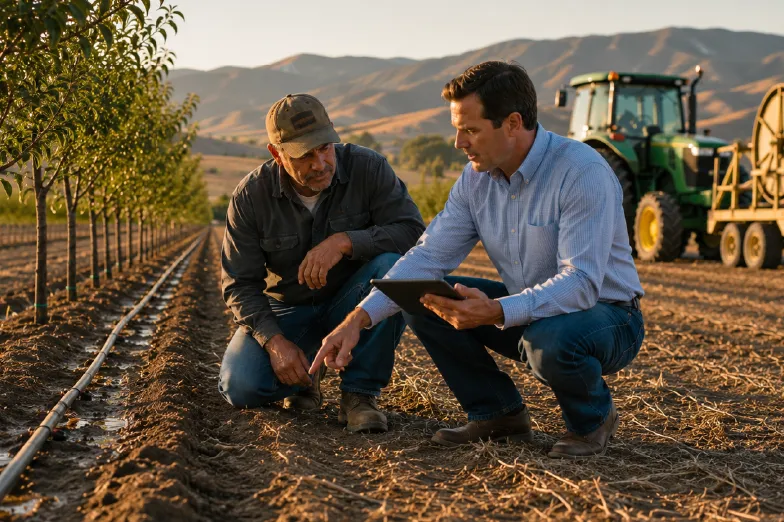
Drainage tile, irrigation systems, wells, fences, culverts, and single-purpose agricultural structures are all depreciable property, often over 7, 15, or 20 years — and much of it now qualifies for 100% bonus depreciation federally, thanks to OBBBA’s permanent restoration for property with a recovery period of 20 years or less. A grower who installed a new irrigation system and treated it as a non-deductible land cost has potentially buried a large first-year deduction.
The California footnote, as always: the state disallows bonus depreciation and caps Section 179 at $25,000, so that irrigation system that vanishes off your federal income in year one keeps depreciating on your California return. Track both. But don’t let the state mismatch scare you off the federal deduction , it’s real, and it’s large.
A Deeper Look: Why “Deductible” and “Deducted Now” Aren’t the Same Thing
The subtle failure in farm returns isn’t usually a fully missed deduction, it’s a deduction taken in the *wrong year*, or against the *wrong income*, so most of its value evaporates. Understanding why requires seeing how these provisions interact.
Consider a grower who has a strong income year and, on a general CPA’s advice, front-loads every deduction: expenses all the fertilizer under §180, deducts a big conservation project under §175, and elects maximum bonus depreciation on new equipment. On paper it looks aggressive and smart. In practice it can be self-defeating.
Why? Because §175 is capped at 25% of farm gross income, over-stacking other deductions can shrink the income that §175 measures against, wasting part of the conservation deduction to a carryforward. Because farm income averaging (Schedule J) could have absorbed that high-income year cheaply by reaching back into prior low-bracket years, but only if there’s still income left to average. And because deductions that push you into a loss may collide with the excess business loss limitation or, in California, the suspended NOL rules for 2024–2026.
The expert move is sequencing. Fill the low brackets with averaging first. Use farm-only current deductions like §175 and §180 where they land against real income. Reserve bonus depreciation, the one tool that can legitimately create a loss, for sheltering off-farm income. A deduction is only worth what it saves, and what it saves depends entirely on where in the stack it sits. Also the taxpayers rate brackets need to be considered so that you don’t continue to waste deductions.
Practical Tips: Deductions to Ask Your Preparer About
- Ask specifically about Section 175. If you did any leveling, grading, drainage, or erosion control this year, ask whether it was deducted currently as a conservation expense or buried in a capital account.
- Elect Section 180 for soil amendments. Confirm your fertilizer and lime were handled as a current deduction, not stretched out, especially for large or multi-year applications.
- Flag every weather-forced sale. If you sold livestock early because of drought or flood, tell your preparer *before* filing so a §451(g) or §1033(e) deferral election can be attached.
- Track off-highway fuel and claim the §6420 credit. Keep a simple log of gasoline used for farming and make sure Form 4136 is filed. It’s a credit, not a deduction — worth more per dollar.
- Depreciate your field infrastructure. Irrigation, tile, wells, fences, and ag structures are depreciable. Don’t let them get lost as “land.”
- Run income averaging before finalizing. After a good year, insist that Schedule J be modeled. It’s the single most commonly skipped farm tax tool.
- Keep the California mismatch in a separate schedule. For every bonus or Section 179 deduction, track the state add-back so a big federal win doesn’t become a surprise California bill.
Conclusion
The deductions California CPAs most often miss aren’t obscure loopholes, they’re the ordinary tools of agricultural taxation that never come up unless the preparer works with farms every day. Conservation and fertilizer expensing turn capital costs into current deductions. Weather deferrals convert a forced sale into a timing win. The fuel credit hands back tax you were never meant to pay. And field infrastructure hides some of the largest depreciation deductions on the farm.
The through-line is that being *eligible* for a deduction means nothing if it’s taken in the wrong year or wasted against income that isn’t there. That’s a sequencing problem, and sequencing is exactly what specialists do. Pull your last two years of returns and check them against this list, if most of these never appear, it’s worth a second opinion from someone who is skilled in farm and ranch taxation.
Frequently Asked Questions
Q: What farm tax deductions do most CPAs miss in California?
A: The most commonly missed California farm tax deductions include Section 175 soil and water conservation expenses, Section 180 fertilizer and lime expensing, weather-related livestock sale deferrals, the Section 6420 federal fuel tax credit, and depreciation of field infrastructure like irrigation and drainage tile. General preparers rarely apply these farm-specific provisions.
Q: Can I deduct soil and water conservation costs?
A: Yes. Under Section 175, farmers can currently deduct qualifying soil and water conservation expenditures, leveling, grading, terracing, drainage, and erosion control, rather than capitalizing them, generally up to 25% of gross farm income, with excess carried forward. The work usually must align with an approved conservation plan.
Q: How does the farm fuel tax credit work?
A: The Section 6420 credit refunds the federal excise tax on gasoline used off-highway for farming purposes, running equipment, pumps, and off-road vehicles. It’s claimed on Form 4136 as a dollar-for-dollar credit against tax, not a deduction, which makes it more valuable per dollar. Growers must track their off-highway fuel use.
Q: What is the tax deferral for weather-related livestock sales?
A: Two provisions help. Section 451(g) lets cash-basis ranchers defer income from livestock sold in excess of normal numbers because of weather to the following year. Section 1033(e) allows deferral of gain on breeding, draft, or dairy animals sold due to weather if they’re replaced, with an extended window in federally declared drought areas.
Q: Is irrigation equipment tax deductible?
A: Yes. Irrigation systems, drainage tile, wells, and similar farm infrastructure are depreciable property, and much of it qualifies for 100% federal bonus depreciation under current law. California, however, disallows bonus depreciation and caps Section 179 at $25,000, so the state deduction is spread over the asset’s normal life.
Q: Should I use a farm tax specialist instead of my regular CPA?
A: If your operation is your livelihood, yes. Agricultural tax provisions like conservation expensing, income averaging, weather deferrals, and fuel credits are routinely missed by general preparers. A specialist also tracks California’s non-conformity to federal depreciation, which can turn overlooked federal deductions into unexpected state liabilities.